Mobile IP Technology and Applications
- By Stefan Raab, Madhavi Chandra
- Published May 11, 2005 by Cisco Press. Part of the Networking Technology series.
Book
- Sorry, this book is no longer in print.
This book is Safari Enabled. When you buy this book, you get free access to the online edition for 45 days.
- Copyright 2005
- Edition: 1st
- Book
- ISBN-10: 1-58705-132-X
- ISBN-13: 978-1-58705-132-6
Real-world solutions for Cisco IOS® Mobile IP configuration, troubleshooting, and management
- Understand the concept of mobility and the requirements of mobility protocols
- Learn necessary components of a Mobile IP network, including features, functions, and message flows
- Examine security concepts related to Mobile IP, including protocol authentication and dynamic keying
- Evaluate high availability solutions and integration with AAA servers in campus networks
- Explore the features of metro mobility, including reverse tunneling, firewall, NAT traversal, and integration with VPN technologies
- Configure IOS Mobile IP networks, including integration topics such as redundancy, QoS, and VPN
- Manage the Mobile IP infrastructure, including Home Address management, scalability considerations, and network management
- Take a look at the future of Mobile IP, including Layer 2 integration challenges, Mobile IPv6, unstructured mobility, and mobile ad-hoc networking
Two of the world’s most powerful technology trends, the Internet and mobile communications, are redefining how and when people access information. With the majority of information and new services being deployed over IP, the use of devices such as cellular phones, PDAs, and laptops for accessing data networks is pushing the need for “always on” IP connectivity. The evolution of mobile computing points to a coming together of the best of desktop computing and cellular communications—the predictability and "always connected" experience of the desktop combined with the ease of use and mobility of the cell phone.
One challenge to mobile data communication is moving data across different networks. The solution to this problem is a standards-based protocol: Mobile IP. Mobile IP is an open standard that allows users to keep the same IP address, stay connected, and maintain ongoing applications while roaming between IP networks.
Mobile IP Technology and Applications is the first book to address the practical application of Mobile IP in real-world environments. Cisco IOS® Mobile IP configuration, troubleshooting, and management are covered in depth and supported by real-world examples. Mobility solutions addressed in this book include enterprise campus wireless LANs and metropolitan mobility for both individual devices and whole networks. Each example is designed to teach configuration, management, and troubleshooting in a manner that is directly applicable to common mobility needs.
Whether you are looking for an introduction to IP mobility or detailed examples of Mobile IP technology in action, Mobile IP Technology and Applications is your complete resource for reaping the benefits that secure, reliable mobile communications have to offer.
"IP Mobility provides the capability not only for me to connect to the world at large, but for it to find and connect to me."
—Fred Baker, Cisco Fellow, Cisco Systems, Inc.
This book is part of the Cisco Press® Networking Technology Series, which offers networking professionals valuable information for constructing efficient networks, understanding emerging technologies, and building successful networking careers.
Links
Read related articles from TechRepublic.com
Identify and reduce mobile device security risks
Take these steps to protect your organization from mobile security threats
Downloadable Sample Chapter
Download - 117 KB -- Chapter 4: IOS Mobile IP in the Lab
Table of Contents
Foreword
Introduction
Chapter 1 Mobile and Wireless Technologies
Mobility
Wireless Technology
Challenges of Communications Mobility
Location Discovery
Move Detection
Update Signaling
Path (Re)establishment
Full Mobility and the OSI Protocol Stack
Mobility at Layer 2
Mobility at Layers 4—7
Mobility at Layer 3
Combining Mobility Protocols
The Case for Mobile IP
Summary
Review Questions
Chapter 2 Understanding Mobile IP
Mobile IP: The Elevator Pitch
Mobile IP Is a Dynamic Routing Protocol…
…Where End Devices Signal Their Own Routing Updates…
…and Dynamic Tunnels Eliminate the Need for Host Route Propagation
Mobile IP: Components
Mobile Node
Home Network and Home Address
Home Agent
Care-of Address
Colocated Care-of Address
Foreign Agent Care-of Address
Foreign Agent
Correspondent Node
Mobile IP Protocol Concepts
Mobile IP Agent Discovery
Location Discovery
Move Detection and Mobile IP Handover Policy
Steady-State Algorithm
New Network Algorithm
Link-State Triggers
Mobile IP Handover
Mobile IP Registration
Identification
Services
Service Fields and Bits
Broadcast Support
Simultaneous Bindings
Authentication
Relevant Address Fields
Registration Reply Codes
Registration Delivery
Mobile IP Handover Other Than Returning Home
Mobile IP Handover Returning Home
Mobile IP Example
Tunneling
Encapsulation
Triangle Routing
Summary
Review Questions
Chapter 3 Mobile IP Security
Protocol Authentication Extensions
Security Associations
SPI
Algorithm and Mode
Key
Replay Protection Methods
Timestamp Replay Protection
Nonces Replay Protection
Mobile Node and Foreign Agent Authentication and Challenge Mechanism
FA Challenge
MN-AAA Authentication
Dynamic Keying
Standards-Based Dynamic Keying
Cisco Dynamic Security Association and Key Distribution
Session Index Extension
Security Association Setup Extension
Domain Extension
Challenge Extension
Authentication Response Extension
Configuration Extensions
Location Privacy
Summary
Review Questions
Chapter 4 IOS Mobile IP in the Lab
Building the Baseline Topology
Intermediate System Configuration
Correspondent Node Configuration
Home Agent Configuration
Physical Home Network Configuration
Virtual Home Network Configuration
Mobile Host Configuration
Security Association Configuration
Home Agent Final Configuration
Foreign Agent Configuration
Mobile Node Configuration
Operation and Evaluation/Troubleshooting
Home Agent
Mobile Node
FA
Examining the Routing Table
Alternative Topologies
Single-Router Topology
Other Options for Single-Router Topology
Summary
Review Questions
Chapter 5 Campus Mobility: Client-Based Mobile IP
Campus Mobility Model
Storing Security Associations in AAA
RADIUS
TACACS+
Cisco Zero Configuration Client
Home Agent Redundancy
Configuration Commands
Active-Standby Home Agent Configuration
Peer-Peer Home Agent Configuration
When to Use Peer-Peer Home Agent Redundancy
Summary
Review Questions
Chapter 6 Metro Mobility: Client-Based Mobile IP
Metro Mobility Model
Reverse Tunneling
Reverse-Tunnel Delivery Style
Reverse-Tunnel Signaling
Reverse-Tunnel Configuration
Tunnel Path MTU
Impact of Network Address Translation
NAT Traversal UDP Tunneling
NAT on the Home Agent
Mobile IP NAT Configuration
Configuration on the Home Agent
Configuration on the FA
VPN Integration
IPSec and Mobile IP
Mobile IP over IPSec over Mobile IP
Resource Revocation
Resource Revocation Overview
Revocation Support Extension and Messages
Registration Revocation Example
Registration Revocation Configuration
Bringing It All Together Through an Example
Evaluating the Metro Mobility Example
Summary
Review Questions
Chapter 7 Metro Mobility: Cisco Mobile Networks
Mobile Router
Mobile Networks (Static or Dynamic)
Configuration of Mobile Router and Its Mobile Networks
Mobile Router Service on an Interface
Mobile Router Interface-Level Configuration
Agent Selection and Mobile IP Registration
Routing to and from the Mobile Router
Home Agent Enhancements
Home Agent Configuration for Network Mobility
Priority Home Agent Assignment
Foreign Agent Details
Agent Discovery–Tuning IRDP Options
Local Routing to Mobile Networks
Configuration for Local Routing to Mobile Networks
Mobile Router Redundancy
Asymmetric Links
Configuration Needed for Asymmetric Links
Example of Asymmetric Link Behavior
Colocated Care-of Address Support
Static Colocated Care-of Address
Dynamic Colocated Care-of Address
Behavior Using Colocated Care-of Addresses
Configuration Examples Using Colocated Care-of Addresses
Example One: Mobile Networks with Static Colocated Care-of Address Only
Example Two: Mobile Networks with Dynamic CCoA
Example Three: Mobile Networks with Dynamic CCoA Only
Quality of Service
IPSec and the Mobile Router
Summary
Review Questions
Chapter 8 Deployment Scalability and Management
Management of the Mobile Nodes Home Address
Virtual Networks
Static Home Addressing Without NAI
Dynamic Home Address Assignment
Fixed Addressing on the Command-Line Interface (CLI)
Local Pool Address Assignment
DHCP-Based Address Assignment
AAA
AAA Address Assignment
AAA-Based Local Pool Selection
AAA-Assigned DHCP Server
Static Home Addressing with NAI
Local Authorization of Static Home Addresses
AAA Authorization of Static Home Addresses
Scaling Issues
Building a Call Model
Number of Nodes
Frequency of Mobility
Amount of Data Traffic
Number of Tunnels
An Example Call Model
Network Management
RFC 2006 Management Information Base (MIB)
Cisco Enterprise MIB
Objects Matching the Call Model
System Log Messages
Common Troubleshooting Issues
Path MTU Discovery
Reverse Path Forwarding Checks
Tunnel Transit
Security Association Incompatibilities
Summary
Review Questions
Chapter 9 A Look Ahead
Mobile IP and Public Access Networks
Public Wireless LAN
Cdma2000 Technology
GSM Technology
FLASH-OFDM Technology
Cisco SWAN and Mobile IP
AAA-Based Dynamic Key Generation
Mobile IPv6
Protocol Operation
Route Optimization (Return Routability) in Mobile IPv6
Mobile IPv6 Messaging
Differences Between Mobile IPv4 and Mobile IPv6
Transition to Mobile IPv6
Lessons Learned
Network Access Identifier
Authentication Option
Bootstrap
Hierarchical Mobile IPv6 (HMIPv6)
Fast Mobile IP
MANET
References
Review Questions
Appendix A Answers to Review Questions
Appendix B IOS Mobile IP: Supported SNMP MIBs
Appendix
Appendix B
Please be sure to view the figures at a minimum of 100%.
Figure B-1 (PDF)
Figure B-1 (JPG)
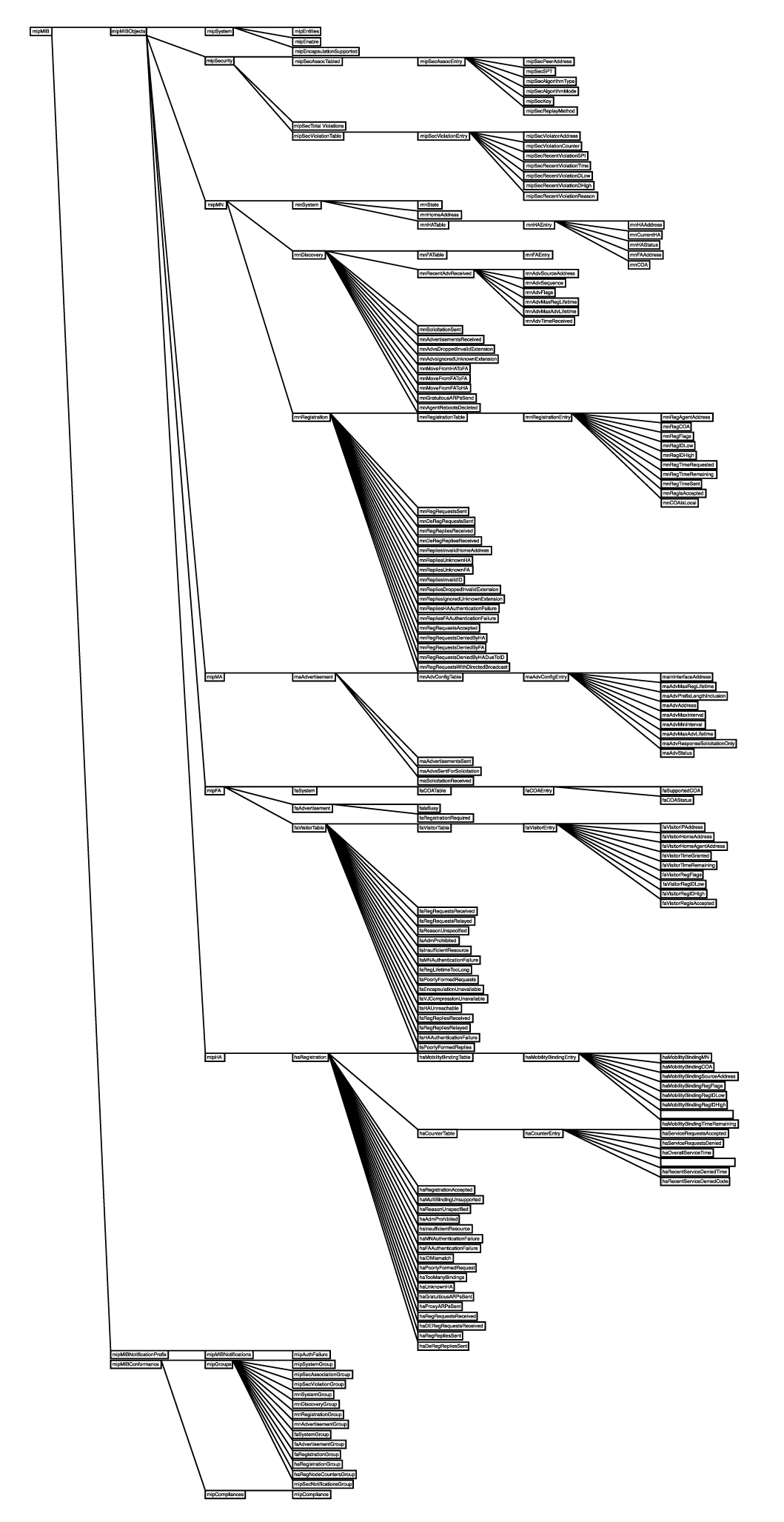
Figure B-2 (PDF)
Figure B-2 (JPG)

Index
Download - 64 KB -- Index